

Your SIP is running. But is it actually working?
Most Indians don’t pick one fund and stick to it. They pick five. A small-cap here, a mid-cap there, a flexi-cap because a friend suggested it. Six months later, the returns don’t match the screenshots they saw online — and they blame mutual funds.
Here’s the truth: mutual funds aren’t the problem. Random fund-picking is.
This guide gives you the best mutual fund for SIP — one fund, chosen by your age and horizon, backed by real rank data and real risk metrics. Not guesswork. Not last year’s chart-topper.
Why Most SIP Portfolios Fail Before They Even Start
The market isn’t the problem. The process is.
People open five SIPs of ₹500-1,000 each. Across categories they don’t fully understand. Because a reel told them to.
Then returns disappoint. And they assume mutual funds don’t work.
They do work. What doesn’t work is investing without a plan.
The One-Fund Question Nobody Answers Properly
If you could only run one SIP for the next 15-20 years, which fund would you choose?
The answer isn’t “whichever gave the highest return last year.”
The answer is: it depends on your age and your horizon.
A 26-year-old and a 48-year-old cannot use the same fund. Their risk capacity is different. Their upcoming expenses are different. Their time to recover from a crash is different.
Why Age and Horizon Decide Everything

In your 20s and early 30s, big expenses are usually 15-20 years away.
Kids’ education. A house. A wedding.
That long runway means short-term market falls barely matter. There’s enough time for the market to recover and compound.
Cross 45, and the picture changes.
Big expenses are closer. Your financial planning needs to shift toward protecting capital, even while some part of your money keeps growing.
That’s the whole point of this article. Not “the best fund” — the best mutual fund for SIP for your specific stage of life.
The Real Mistake: Chasing Past Returns
Here’s where almost everyone goes wrong.
They see a fund that gave 25-28% annualised returns over five years. They assume it’ll repeat.
It might. It might not.
Past performance is not a guarantee of future returns. SEBI makes every mutual fund say this for a reason.
So if return isn’t the right filter — what is?
What a Fund’s Rank Actually Tells You
Think about how you’d judge a student.
You wouldn’t look at one test score. You’d look at their marksheet. Their consistency. Their rank among peers.
A fund’s category rank works the same way.
A small-cap manager choosing from 6,000-7,000 listed companies, still landing a top-3 rank with under 70 stocks — that’s not luck. That’s skill. Research. Conviction.
That’s why every fund below is picked using rank, portfolio structure, and risk-adjusted metrics. Not just trailing returns.
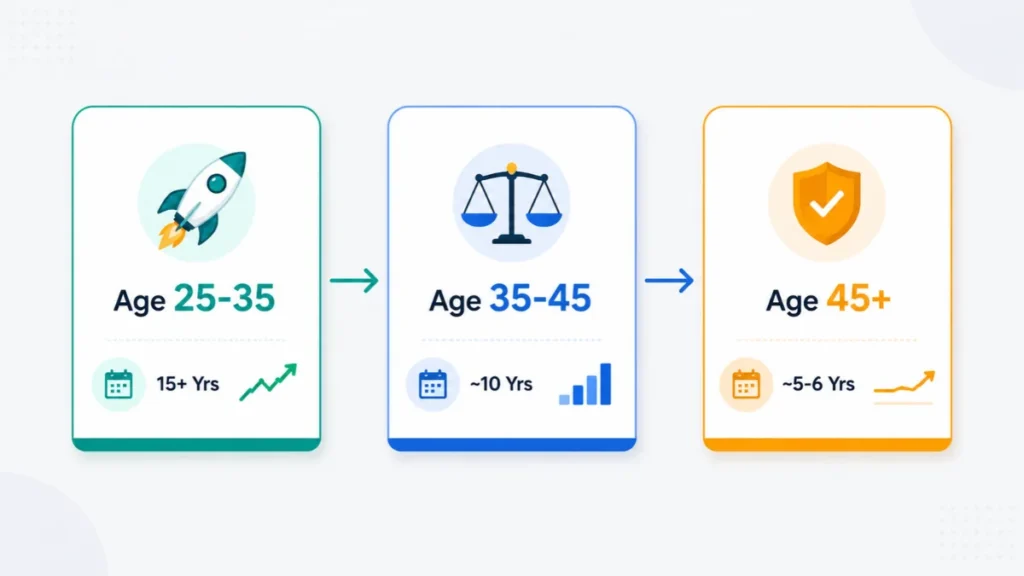
Best Mutual Fund for SIP: Age 25-35 (Horizon 15+ Years)
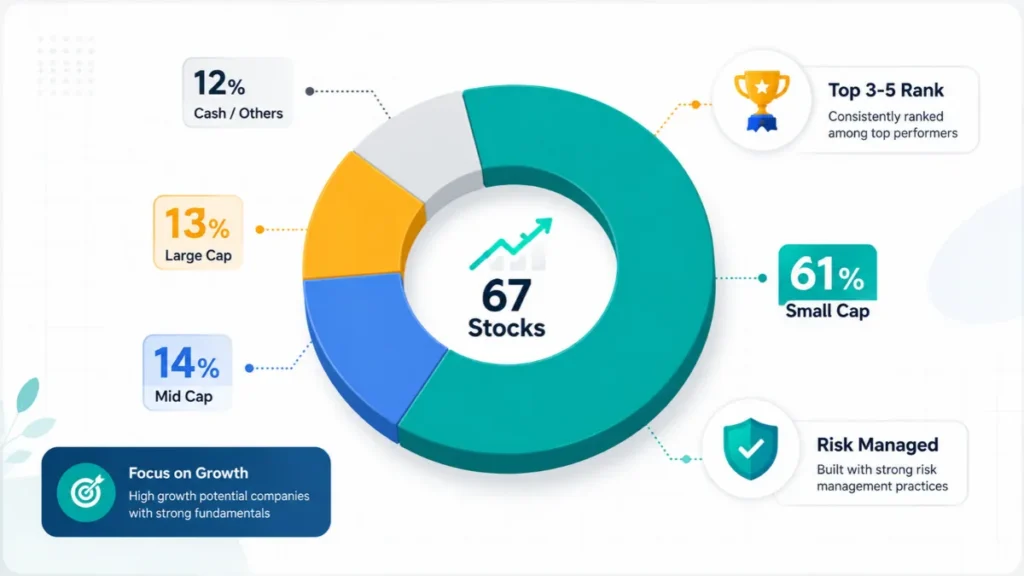
If you’re in your 20s or early 30s with a long runway, Invesco India Smallcap Fund is a strong single-fund pick.
Why This Fund Beat 30+ Rivals
The portfolio holds roughly 67 stocks. Small, by category standards.
Yet it has consistently ranked among the top 3-5 funds out of more than 30 comparable small-cap schemes.
That’s not luck. That’s stock-picking discipline in a category where managers can choose from thousands of companies.
The allocation: roughly 61% small cap, 14% mid cap, 13% large cap. A small cushion built in.
The AUM Myth Nobody Explains Properly
“This fund’s AUM is only ₹14,000-15,000 crore. Isn’t a bigger fund safer?”
Not necessarily. Here’s why.
Small-cap stocks don’t trade in high volume. If a fund with a huge corpus buys a big chunk in one go, it can push the stock into an upper circuit. That distorts prices for everyone.
SEBI’s own FY26 stress-test data shows some of the largest small-cap schemes needed 38 to 51 days to sell just half their portfolio. Mid-cap funds of similar size took only 17-23 days.
That’s the real risk in this category. And it’s exactly why fund managers keep the stock count deliberately tight.
As this fund’s AUM grows, expect the stock count to grow too — not because the strategy changed, but because liquidity demands it.
Risk Metrics That Matter More Than the Return Number
Standard deviation: around 19.5%. Moderate, for small-cap.
Sharpe ratio: close to 0.87. A solid risk-adjusted score.
Who should skip this fund: anyone with a horizon under 10 years. Small caps are volatile. This fund is built for patience, not for money you’ll need in 3-5 years.
Best Mutual Fund for SIP: Age 35-45 (Horizon ~10 Years)
Mid-career, roughly a decade to your goals? Motilal Oswal Multicap Fund fits.
A Deliberately Concentrated Portfolio
Close to 38 stocks. Far fewer than most multicap peers, who often hold 100+.
That’s Motilal Oswal’s style. Fewer bets. Deeper research. Higher conviction per holding.
Allocation across all three market caps: roughly 34% large cap, 25% mid cap, 22-23% small cap.
Real multicap diversification. Not a large-cap fund wearing a multicap label.
Why a Short Track Record Isn’t Disqualifying
This fund is new. It doesn’t have a decade of data yet.
What it does have: a first-place rank in its category among newly launched multicap peers.
A meaningful early signal. Worth watching over the next few years to confirm consistency.
The caveat: treat any short-term returns here as directional, not final. If you want a best mutual fund for SIP with a 10-year mindset, this fits — as long as you’re comfortable backing a strong manager early.
Best Mutual Fund for SIP: Age 45+ (Horizon ~5 Years)
Past 45, your runway is shorter. Retirement top-ups. A child’s wedding. Bigger expenses, closer in time.
For this stage, quant Aggressive Hybrid Fund makes more sense than pure equity.
Why Hybrid, Not Pure Equity
The split: roughly 76% equity, 16% debt, rest in cash.
Equity drives growth. Debt cushions the fall when markets drop.
Exactly what a 5-6 year horizon needs.
The equity book itself stays conservative: around 64% large cap, 7% mid cap, zero small cap.
That’s deliberate. At this stage, protecting capital matters as much as growing it.
A Track Record Long Enough to Trust
This fund has run since January 2013. Over a decade of data.
Full market cycles. Corrections. Recoveries.
That long history is exactly what makes its risk metrics worth trusting — unlike a fund that’s only 1-2 years old.
Quick Comparison: Best Mutual Fund for SIP by Age
| Age Bracket | Horizon | Fund | Category | Best For |
|---|---|---|---|---|
| 25-35 years | 15+ years | Invesco India Smallcap Fund | Small Cap | Long-runway, high-risk-appetite investors |
| 35-45 years | ~10 years | Motilal Oswal Multicap Fund | Multicap | Balanced growth across market caps |
| 45+ years | ~5-6 years | quant Aggressive Hybrid Fund | Aggressive Hybrid | Capital protection with moderate growth |
This table isn’t “best to worst.” It’s a map of what fits which life stage. Use it as a starting point — not a substitute for your own research.
The Reality Check Every SIP Investor Needs
None of the numbers above are promises.
SEBI and AMFI guidelines suggest assuming 10-12% annualised returns for equity mutual funds, long-term. Regardless of category. Regardless of past performance.
Markets can beat this in a strong bull run. They can fall short in a downturn.
Nobody can guarantee which one you’ll get during your SIP journey.
Still deciding between investing in chunks or all at once? Our SIP vs Lumpsum breakdown covers exactly which approach fits which situation.
New to how SIPs actually work? Start with our complete guide to SIP in mutual funds.
Thinking specifically about your post-retirement runway? Read our piece on retirement-focused mutual fund planning alongside this one.
And whatever fund you pick — remember, redemptions get taxed. Our mutual fund taxation guide breaks down exactly how much, and when.
FAQ
Is it OK to invest in only one mutual fund for SIP?
Yes. For many investors, one well-chosen fund is genuinely enough, especially if it’s diversified across market caps and matches your risk appetite. The number of funds you own matters less than whether the one you own actually fits your goal.
How many mutual funds should I have in my SIP portfolio?
There’s no fixed number. What matters is purpose. If one fund covers your goal, horizon, and risk profile, adding more may just create overlap, not real diversification.
Should I choose a mutual fund based on past returns?
No. Past returns show what already happened, not what’s coming next. A fund’s category rank, portfolio construction, and risk-adjusted metrics like Sharpe and Sortino ratio tell you far more about the manager’s actual skill.
What is a good CRISIL or Value Research rank for a mutual fund?
Generally, a rank in the top 10-20% of a category, such as Rank 1, Rank 2, or a 4-5 star Value Research rating, signals strong, consistent performance. Always compare within the same category.
Is a small-cap fund good for a long-term SIP?
It can be. Small caps compound well over long periods, but they carry real short-term volatility and liquidity constraints. Suited for investors with a 10-15+ year horizon who won’t panic-sell during a downturn.
How much return can I realistically expect from an SIP?
Assume 10-12% annualised, long-term, for equity mutual funds, as per SEBI/AMFI guidance. Actual returns will swing year to year based on market conditions.
The Bottom Line
The best mutual fund for SIP isn’t the one with the flashiest five-year chart.
It’s the one that matches your age, your horizon, and your risk capacity — and one you’ll actually stay invested in.
A 26-year-old chasing 15-year compounding needs a completely different fund than a 48-year-old protecting capital five years out.
Get that match right, and one disciplined SIP can outperform five scattered, poorly-chosen ones.
Start with clarity, not chart-chasing. Your future net worth depends more on today’s decision than on last year’s leaderboard.
Disclaimer: This article is for educational purposes only and does not constitute financial advice. Mutual fund investments are subject to market risks. Past performance is not indicative of future returns. All fund data, rank, AUM, and performance figures mentioned are based on publicly available sources at the time of writing and are subject to change. Please read all scheme-related documents carefully and consult a SEBI-registered financial advisor before making any investment decision based on your personal goals and risk profile.
References & Data Sources
This article is based on fund data, regulatory guidance, and rank methodologies from trusted financial sources.
-
1
FY26 stress test data on small-cap and mid-cap mutual fund portfolio liquidation timelines.
-
2
Research and investor education guidance on realistic long-term SIP return expectations.
-
3
Percentile-based ranking system used to evaluate fund performance and risk within peer categories.
-
4
Fund-level data on AUM, expense ratio, and category performance for Invesco India Smallcap Fund.