
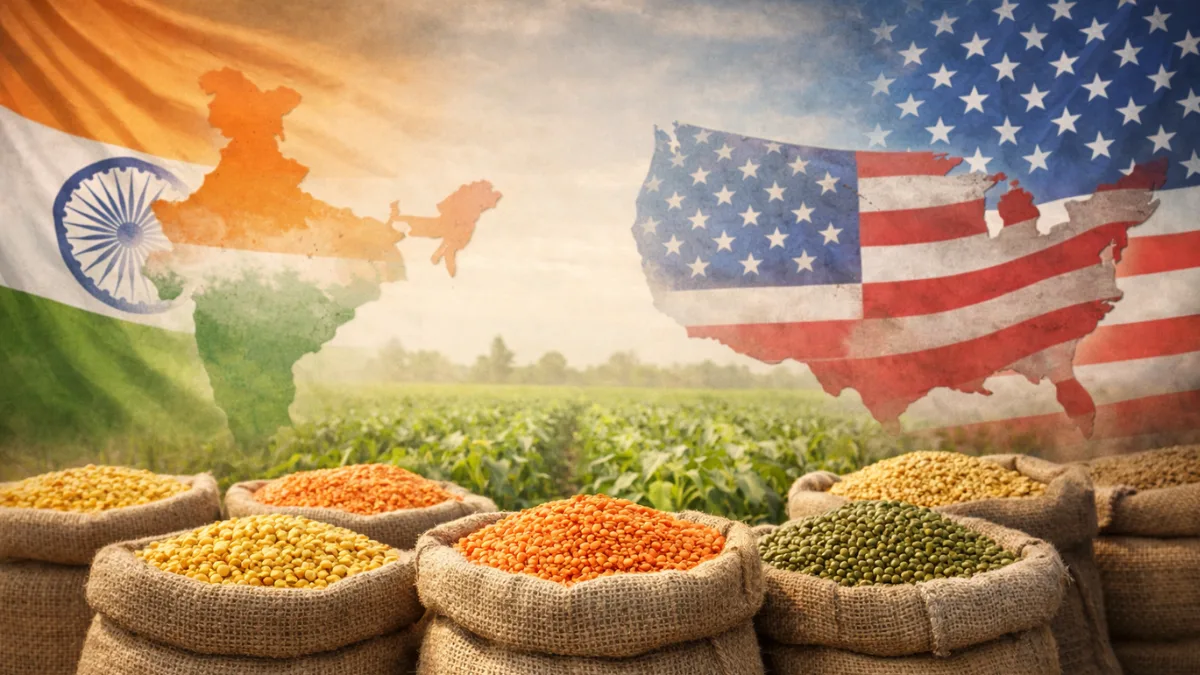
It happened quietly, without headlines or official announcements, yet it carries serious consequences for global trade.
A single tariff decision by India has unsettled American farm states and added fresh tension to bilateral talks.
This article explains the real reason, the silent strategy, and what the India US pulses tariff actually means.
A Tariff That Few Noticed
India has imposed a 30% import duty on pulses and lentils originating from the United States, a move that largely escaped public attention when it was implemented.
The tariff has been in effect since late last year, according to official sources, but was introduced without a formal public announcement.
Despite the lack of publicity, trade and policy circles see the decision as a deliberate and calculated step, not an administrative oversight.
Why the India US Pulses Tariff Matters
Pulses are not just another agricultural commodity for India.
The country is the world’s largest consumer of pulses, accounting for more than a quarter of global demand, which gives New Delhi significant leverage in global markets.
Any shift in the India US pulses tariff directly affects exporters, pricing dynamics, and future trade negotiations.
The Retaliation Context
Policy experts widely interpret the tariff as a retaliatory response to higher duties imposed earlier by the United States on certain Indian products.
Rather than escalating the dispute publicly, India appears to have chosen a quieter route.
This “silent retaliation” reflects a broader strategy of asserting trade autonomy without provoking immediate diplomatic fallout.
Growing Unease in the United States
The decision has triggered concern within American agricultural and legislative circles, particularly in pulse-producing states such as North Dakota and Montana.
Farmers and exporters fear that the higher duty could sharply reduce shipments to one of their most important markets.
For U.S. producers, the India US pulses tariff threatens both volumes and long-term market access.
Pressure From U.S. Lawmakers
The issue has now reached political levels in Washington.
U.S. senators have formally raised objections, calling the tariff “unfair” and urging the White House to push for its removal.
They argue that American pulse crops face restricted access, while Indian markets remain heavily protected.
India’s Red Lines on Agriculture
Indian officials, however, have made it clear that agriculture remains a sensitive sector.
Protecting domestic farmers, ensuring food security, and maintaining price stability are viewed as non-negotiable priorities.
From New Delhi’s perspective, the India US pulses tariff falls within internationally permissible measures to safeguard domestic interests.
Trade Talks Under Strain
The tariff has added complexity to already slow-moving trade discussions between India and the United States.
Both sides have expressed interest in expanding bilateral trade, yet disagreements over agricultural access continue to stall progress.
Experts caution that unresolved disputes over pulses could spill into broader negotiations.
A Global Trade Pattern
Analysts also place India’s move within a wider global context.
Across regions, governments are increasingly using tariffs to protect domestic producers amid supply-chain vulnerabilities and geopolitical uncertainty.
In this environment, the India US pulses tariff is seen less as an isolated action and more as part of a global protectionist shift.
India’s Domestic Agriculture Considerations
From India’s perspective, the tariff move is closely tied to domestic agricultural stability. Pulses are a sensitive commodity, influencing both farmer incomes and retail food prices. Policymakers remain cautious about sudden import surges, which can push down local prices and create stress for small and marginal producers.
At the same time, managing food inflation remains a priority. By keeping duties elevated, authorities aim to balance consumer affordability with long-term farm sustainability. The approach reflects an effort to protect rural livelihoods while avoiding abrupt market distortions during a period of heightened economic and political sensitivity.
What Happens Next
Officials indicate that the tariff will remain under periodic review and could be recalibrated depending on future negotiations.
India has reiterated its openness to dialogue, provided discussions are guided by reciprocity and fairness.
For now, the silent tariff stands as a clear signal of India’s trade priorities—and a reminder that in global commerce, quiet decisions can carry loud consequences.